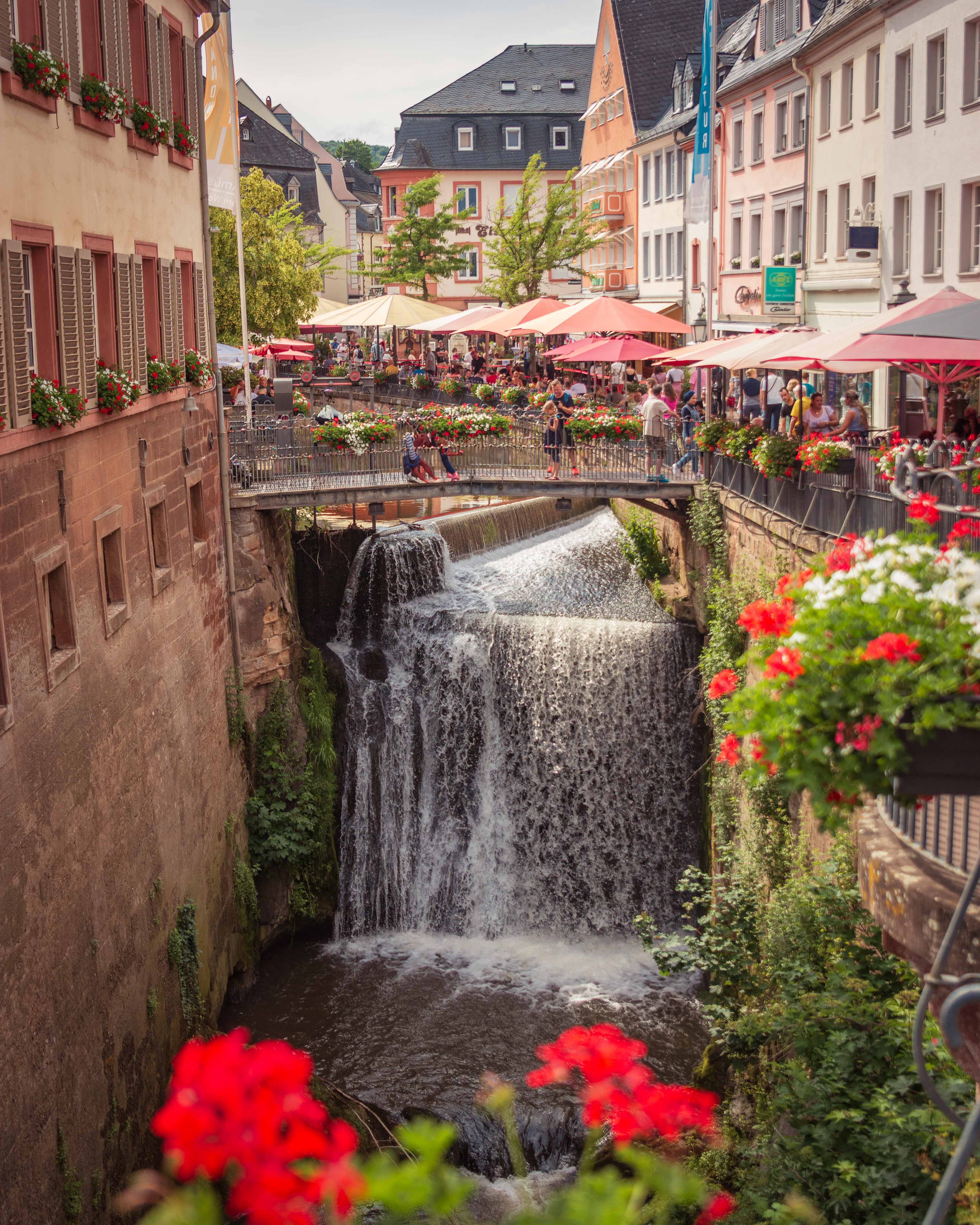
Welcome to Saarburg! This charming town is a gem, much like many found throughout Germany — yet it boasts a unique feature that sets it apart: a stunning waterfall cascading right through the heart of the town, accompanied by a delightful creek that winds its way through the center as well.
There’s rich history, impressive castles, a chairlift that glides over the vineyards, and an exhilarating summer toboggan run. During our visit, we explored the castle, admired the church, enjoyed a lovely lunch, and wandered through the charming streets — not to mention the museum and numerous old mills that dot the landscape. It truly felt like an enchanting town, and we couldn’t wait to delve deeper into its wonders.
If you want to get a real feel for Saarburg before you go, be sure to watch our video for a closer look at the charming Old Town, Castle ruins, and cozy cafés.
What is the closest airport to Saarburg?
The closest airport to Saarburg, Germany is Luxembourg Airport (LUX), located about 40 kilometers (25 miles) away — roughly a 35–45 minute drive. It’s the most convenient international airport for visitors and offers connections to many major European cities.
Another nearby option is Frankfurt-Hahn Airport (HHN), about 80 kilometers (50 miles) away, which primarily serves low-cost carriers. For long-haul international flights, Frankfurt International Airport (FRA) is a larger hub located approximately 200 kilometers (125 miles) from Saarburg.
Nestled in the heart of beautiful Rhineland-Pfalz (Rheinland-Palatinate) right across the border from Luxembourg—just 30 minutes from Trier and a little over an hour from Kaiserslautern—Saarburg is a hidden gem that feels like it was pulled straight from the pages of a fairytale.
Perfect for day trips from Trier, weekend getaways in western Germany, or scenic road trips near Luxembourg, Saarburg is one of Germany’s most underrated small towns—and once you discover it, you’ll wonder how it’s stayed a secret for so long. Be sure to check out all of the best things to do in Saarburg, Germany during your visit.
The stream side cafes offer an incredible setting.
Is Saarburg a walkable city?
Saarburg is a very walkable city. The historic old town is compact and easy to explore on foot, with most attractions located within a short distance of each other. You can stroll along the canal to see the famous 20‑meter waterfall, browse small shops, relax at riverside cafés, and climb up to Burg Saarburg for panoramic views—all without needing a car. The cobblestone streets and pedestrian-friendly layout make it ideal for a relaxed walking tour, though comfortable shoes are recommended due to some hills and uneven surfaces.
To experience Saarburg, Germany beyond the photos, watch our Saarburg travel vlog on YouTube featuring the stunning waterfall, charming old town, and riverside cafes — and don’t forget to subscribe for more Germany travel guides!
This picturesque German town combines storybook medieval charm, peaceful riverside views along the Saar River, and a dramatic 20-meter waterfall crashing right through the center of the old town. These features make it one of the top destinations for those searching for saarburg germany things to do.
When is the best time of day to visit Saarburg, Germany?
The best time to experience the Saarburg waterfall is in the morning, when the light is perfectly positioned behind you—illuminating the colorful buildings and making the scene even more picturesque.
The Leukbach stream, which feeds the waterfall, was rerouted in the 13th century to help provide water for firefighting and to power mills. Today, those same mills form part of a fascinating mill museum that’s open to visitors.
What to Do and Eat in Saarburg Germany
Little Venice: The Waterfall in the Heart of Saarburg Germany
In the heart of Saarburg, something incredible happens: a roaring waterfall crashes right through the center of town. Surrounded by centuries-old buildings and cobblestone streets, this 20-meter cascade turns an ordinary village into something unforgettable.
This part of town, where the creek runs through, is called — not surprisingly — Little Venice, although we haven’t seen any gondolas here yet. The creek is called the Leuk Bach (“Bach” means creek in German), and it originally encircled the town in the early Middle Ages, running around the castle on the hillside just outside town.
In the 13th century, the town diverted the creek to run straight through the middle of Saarburg — for fire prevention, so there would be enough water on hand in case of a fire in town.
If you look around, you’ll also spot a Luxembourg flag on some of the flower boxes — we’re really close to Luxembourg here. Luxembourg City is only about 30 miles away. If you’re familiar with Rhineland-Palatinate at all, the city of Trier is only about 15 miles away too.
So if you’re exploring the area, Saarburg makes a great day trip stop. (And if you don’t know about Trier, check out our video on Trier — it covers everything to do there, including the Roman ruins and the beautiful city itself.)
As you walk through town, look closely at some of the narrow buildings along the creek. According to what we read, they put oak poles into the ground centuries ago — some of these buildings are probably 500 years old or older, built on top of those oak poles after the creek was diverted through town. Quite an architectural feat.
History buffs will appreciate the Amüseum, housed in a historic mill, showcasing traditional trades powered by water. Nearby, the neo-Gothic St. Laurentius Church offers a peaceful moment of reflection with its beautiful stained glass and serene interior. Just a short walk away is the Glockengießerei Mabilon, a former bell foundry turned museum, where you can see how bells were once cast and learn more about Saarburg’s industrial past.
The Watermill Museum
A village from the Middle Ages with a stream running through it, as you might expect, had a lot of mills. You can still see several water mills running along the creek today, and there’s a watermill museum in town that opens at 11:00 (it seemed to be open daily, though we didn’t manage to make it inside on our visit). It looks really interesting to look down on the still-functioning watermills. There are also some really big fish in the creek — worth a look if that’s your thing.
This part of town is called the Horse Market, or the Butter Market — apparently at one point they sold horses and butter here. It’s the center of town, the pulsating heart of Saarburg.
We got hungry and stopped for an early lunch around 11:00 — right in the gap between breakfast service ending and lunch service starting at 11:30. So we sat down, ordered a beer, and waited it out.
For lunch, we split a Flammkuchen — a bit of an international treat in this region, actually thought to originate in Alsace, France. It’s a very thin dish, kind of like a pizza with a white sauce, traditionally topped with onion and a little bacon — really tasty. We also had spaghetti bolognese, which you can find at virtually any Italian place. Nothing that’s going to win any Michelin stars, but it smelled good and tided us over for the rest of the afternoon.
The view didn’t hurt either — right along the creek/canal, with nice flowers all around.
Total for the meal (at Hotel Amat): €42 for both of us, which included three beers, a plate of spaghetti bolognese, and a Flammkuchen. Definitely worth it.
A fun moment: our server’s name was Renee — not a typical German name — and when we asked where he was from (in German), we did not expect the answer to be New York City. Renee has actually been living in Germany for about 40 years, splitting his time between Hamburg (Germany’s second-largest city, up north) and Saarburg. You never know who you’ll run into or where they’re from when you’re traveling — so next time you’re having lunch somewhere, ask your server where they’re from. You might be surprised.
St. Laurentius Church
The St. Laurentius Church in Saarburg was originally built in the 1300s and offers some very nice views of the city from the outside. What’s interesting on the inside is that basically half the church was destroyed during air raids in World War II — the target was actually the bridges on the Saar River, but the church was hit by accident. So today, the columns on one side were rebuilt in the 1940s after the war, while the columns on the other side are the original, centuries-old ones. Half the church is modern, half is very old.
Chairlift Over the Vineyards & Summer Toboggan Run
From just outside the town center, you can take a chairlift up over the vineyards. Pricing:
One way up: €5 per adult
Round trip: €8 per adult
We rode it up and planned to hike back down. At the top, there’s also a summer toboggan run (Sommerrodelbahn) — just €3 per person, which is a great deal. It’s more like riding down a big slide in a cart than a full roller-coaster-style run, but it was a lot of fun, and plenty of kids were riding it and really getting some speed (we were more tame about it). You can also buy 10 rides for around €20-25, which is a much better bargain than a similar ride we did in Leavenworth, Washington, where a single ride cost $20.
After the toboggan run, we walked back down through the vineyards to town — a really nice stroll with great views along the way.
The Old Customs Tower & Saar River
Along the Saar River sits one of the last remaining parts of Saarburg’s original medieval fortification. This tower also served as the town’s customs point — ships trading along the Saar River would stop here to go through customs when bringing goods into town. It’s also said to have served as an icebreaker point on the river.
There are nice vineyards and views of the city from here, plus a lovely trail right along the river for a stroll. A couple hundred meters down the trail, you can hop on a boat for a river cruise along the Saar — about 1.5 hours long, priced around €18 per person round trip. A really pleasant way to spend an afternoon on a sunny day in Germany.
Kaffee und Kuchen (Coffee & Cake) Break
No German day trip is complete without an afternoon coffee and cake stop. We had a Nuss-Nougat (nut-nougat) cake and a latte macchiato with a little heart on top. A cafe iced coffee (ice cream with coffee in it) was also on the table, along with a bottle of water — which, to our surprise, came with ice cubes, something you don’t always see when traveling through Europe. A refreshing pick-me-up before heading to the castle.
The Saarburg Castle Ruin is an easy walk from town, though we drove up since our paid parking had run out (parking at the castle itself is free, and so is entry to the castle).
The complex was built in the late 1200s to early 1300s and is a genuinely interesting fortification, with really thick walls and a cool tower you can climb (worth it for the views, though it’s windy up there). Part of the castle now houses a restaurant that looks really nice — unfortunately it’s closed on Tuesdays and Wednesdays, so we missed out, but it’s open again Thursdays.
The views from the castle over the Saar River are excellent. Right across from the castle, there’s also a canoe and kayak rental spot if you want to get out on the river.
Is Saarburg Worth a Day Trip?
Absolutely. If you live around the Kaiserslautern or Luxembourg area and are looking for a place to go, Saarburg is a fantastic day trip — waterfalls, a medieval old town, a working watermill museum, a castle ruin, a chairlift over the vineyards, a summer toboggan run, and river views, all in one small, walkable town.
Saarburg may not be on the usual tourist trail, and that’s exactly what makes it so special. It’s a peaceful escape full of charm, history, and surprising moments—like a waterfall rushing through a town square. If you’re visiting Trier, exploring the Moselle Valley, or stationed near Ramstein or Frankfurt, make sure Saarburg is on your list of day trips. You won’t regret it.
We’re Lee and Betty, an American couple who’ve been living, working, and traveling across Europe for over 30 years.
Over four years ago, we retired in Germany and began a new adventure. On Traveling Expats, we share honest stories, slow travel tips, and detailed Germany & Europe travel guides to help you plan unforgettable trips.
Colmar looks like a fairytale in Christmas photos but does the real thing live up to the hype? Here’s our honest take, plus everything you need to know: all 6 official markets, parking, crowds, and how to get there.
Affiliate Disclosure
Some of the links on this site are affiliate links. If you click through and make a purchase, we may earn a small commission at no extra cost to you. We only recommend products and services we use or genuinely believe in.




Leave a Reply