Mainz Germany Travel Guide: Best Things to Do and Eat in Mainz in 1–2 Days
In this Mainz, Germany travel guide, we’ll show you the best things to do in Mainz, top attractions, local food spots, and how to experience the city in 1-2 days.
Mainz is a historic city in western Germany, located on the Rhine River in the state of Rhineland-Palatinate. It sits just a short train ride from Frankfurt, making it a perfect day trip destination for travelers exploring the Rhine and Rheinhessen wine region.
TIP: If arriving by train, get off at Mainz Römisches Theater instead of Mainz Hauptbahnhof. It’s closer to the Old Town (Altstadt), less hectic, and within easy walking distance of the Rhine, Mainz Cathedral, and main attractions.
Whether you’re visiting as a day trip from Frankfurt or staying overnight, Mainz is one of the most enjoyable small cities in Germany to explore.
We visited Mainz and explored the old town, riverfront, and local wine bars. Watch the full experience below.
What Can You Do in Mainz in 48 Hours? Quite a Lot, Actually!
Nestled along the banks of the Rhine River, Mainz is one of Germany’s most underrated city breaks. Known as the birthplace of Johannes Gutenberg, the inventor of the movable-type printing press, this historic city combines Roman heritage, medieval architecture, vibrant wine culture, and a lively local atmosphere that makes it easy to fall in love with.
From wandering through the charming Old Town and admiring the stunning Mainz Cathedral to relaxing in bustling market squares and riverside wine gardens, Mainz offers the perfect mix of history, culture, and local flavor.
As the capital of Germany’s Rheinhessen wine region, it’s also a fantastic destination for anyone who enjoys great food and exceptional wine.
We spent our 2 days in Mainz sampling local wines, eating our way through local markets, soaking in the history in museums and cathedrals, partaking in a few local traditions, and doing a lot of walking to enjoy those city views.
Mainz Travel Guide: What to Do, See, Eat, Drink & Experience in Mainz Germany in 2 Days!
Visit Mainz Cathedral (Mainzer Dom)
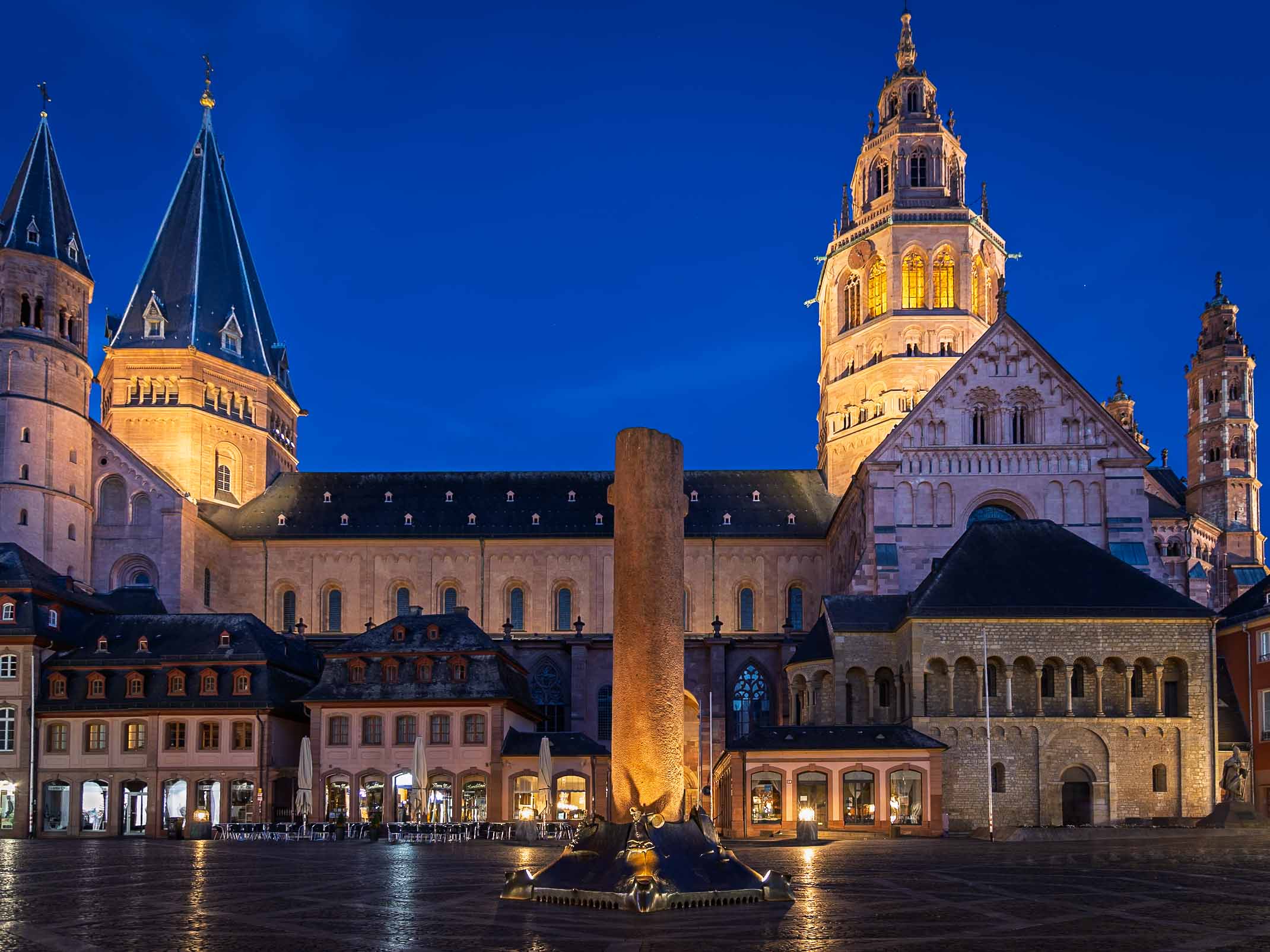
No visit to Mainz is complete without stepping inside the magnificent Mainz Cathedral (Mainzer Dom), one of Germany’s most important and historic churches. Dominating the city’s market square for more than 1,000 years, the cathedral is an impressive blend of Romanesque, Gothic, and Baroque architecture that reflects the many centuries of its construction and restoration.
The locals often joke that the cathedral is “almost” a thousand years old due to its fascinating history. Upon its completion, the cathedral was illuminated with candles and torches to highlight its beauty and grandeur; however, this extravagant display led to a devastating fire that required significant rebuilding.
Remarkably, the reconstruction was completed swiftly, but the cathedral’s trials didn’t end there, as it has since endured six more fires throughout its storied existence. This resilient landmark stands as a testament to its enduring legacy and the dedication of the community that restored it time and again.
As you wander through its massive red sandstone interior, you’ll discover ornate chapels, beautiful stained-glass windows, and the tombs of powerful archbishops who once shaped the history of the Holy Roman Empire.
Be sure to check out the crypts on both sides of the cathedral, as they are free to explore. Whether you’re interested in history, architecture, or simply looking for a quiet place to escape the bustle of the city, Mainz Cathedral is a must-see attraction and one of the highlights of any visit to Mainz.
Visit the Mainz Market: Fresh Produce, Local Wine & Street Food
If you’re visiting Mainz on a Tuesday, Friday, or Saturday, make sure to experience the city’s lively weekly market in the heart of the Old Town.
This bustling market is one of the best places to soak up local life in Mainz, with stalls overflowing with fresh regional produce, vibrant flowers, local wines from the Rheinhessen region, and a variety of delicious street food and snack vendors. It’s the perfect spot to sample authentic flavors, pick up local specialties, and enjoy the atmosphere around the historic city center.
A bottle of red wine replaces 26 semesters of Philosophy studies.
Two of the most popular food trucks at the Mainz market had huge lines, and it was easy to see why. One was serving traditional Fleischwurst with a Brötchen, a true local specialty of Mainz and a must-try if you want to experience authentic regional street food.
The other was serving freshly made fried fish sandwiches, another classic German market favorite. Of course, we couldn’t resist trying both, and honestly, they were equally amazing.
The Fleischwurst was hearty, flavorful, and perfectly simple, while the fish sandwich was crispy, fresh, and full of flavor. It was the kind of local food experience that makes visiting the Mainz market so memorable.
The market closes promptly at 2pm, so it’s best to arrive earlier in the day when the selection is at its best and the atmosphere is a little more relaxed. As the morning goes on, it becomes increasingly popular with both locals and visitors, adding to its vibrant and energetic feel.
Gutenberg Museum: Where Printing History Began
A visit to the Gutenberg Museum is certainly something you should definitely check out during your trip to Mainz, especially for anyone interested in history, books, or how modern communication began. However, please note that the museum is currently under renovation until 2032, and the exhibit has been relocated to the Natural History Museum. Additionally, the museum is closed on Mondays.
Dedicated to Johannes Gutenberg, the inventor of the movable-type printing press, the museum brings his world-changing innovation to life with fascinating exhibits, original printing presses, and beautifully preserved early printed books. Some of the museum’s greatest treasures are two Gutenberg Bibles with 42 lines, printed in the middle of the 15th century.
What many visitors don’t realize is that Gutenberg was actually born Johannes Gensfleisch. The name “Gutenberg” came later, taken from the house his family lived in at the time. It’s a small detail, but one that makes his story even more interesting and personal.
Walking through the museum, you really get a sense of how revolutionary his invention was and why Mainz is considered such an important city in the history of the written word.
We stopped for our usual Kaffee und Kuchen break at the Dom Café in Mainz’s main square, and it honestly felt like heaven. The selection of cakes looked absolutely incredible, from traditional German tortes to freshly baked pastries, and the coffee was exactly what we needed for an afternoon pick-me-up while exploring the city.
Sitting outside in the heart of the Mainz Market Square (Marktplatz), especially after the weekly market had wound down, made the experience even better. With the square becoming a little quieter, it was the perfect moment to relax, soak in the beautiful surroundings of Mainz Cathedral, and enjoy some classic people-watching in one of the most atmospheric spots in the city.
Exploring Kirschgarten and Mainz Old Town (Altstadt)
After Kaffee und Kuchen in the main square, you’re already in the heart of Mainz’s Altstadt, so you’re perfectly positioned to wander without any planning stress. From there, heading to the Kirschgarten is ideal.
The name “Kirschgarten” is a charming nod to the spring “Kirschborn,” and it’s fascinating to think this square has been part of Mainz’s story since 1329.
Nestled amidst the delightful ensemble of half-timbered houses, sandstone, and cobblestones, you’ll find the Haus zum Aschaffenberg, boasting the title of the oldest known half-timbered house in Mainz, constructed around 1500.
Oldest wine house in Mainz Old Town serving traditional food and regional Rheinhessen wine.
Imagine that—a piece of history that has stood the test of time! Its late medieval predecessor was first documented back in 1448. What’s even more special is that this area was largely spared from the ravages of war, allowing us to enjoy these original buildings just as they were centuries ago, filled with stories waiting to be told.
From Kirschgarten, you can naturally continue exploring deeper into the Old Town (Altstadt). This is where Mainz really comes alive in a slower, more intimate way: narrow streets, hidden courtyards, small boutiques, and little cafés tucked into historic buildings. It’s also a great area to just wander without a fixed route, because everything connects easily on foot.
Dinner in Mainz Old Town: A Traditional Weinhaus Experience
We ended up at Weinhaus Hottum in Mainz Old Town and were lucky enough to get a table without a reservation. As is common in traditional German wine taverns, we shared a table with another couple, which added to the friendly, communal atmosphere and felt completely natural for a busy Weinhaus in Mainz.
The atmosphere inside was lively, warm, and full of energy, making it a great spot to experience authentic local dining in the heart of the city. We enjoyed a refreshing and surprisingly strong Weinschorle (wine spritzer), along with a local specialty, Spundekäs, served with small pretzels.
For our main dishes, we ordered a classic schnitzel with potato salad. The potato salad came with cucumbers, which initially caught us off guard, but it turned out to be a delicious and slightly different take on a traditional German side dish.
Overall, it was a fun and very local dining experience that perfectly captured the charm of eating out in a traditional Mainz wine house.
Evening Walk Through Mainz Old Town, Rhine River & Illuminated Cathedral
After filling up on delicious local food and wine, we took a relaxed evening stroll through Mainz Old Town (Altstadt), enjoying the quiet streets and historic atmosphere after dark. From there, we made our way down to the Rhine River, where the riverside promenade offered a peaceful contrast to the lively wine house earlier in the evening.
We then looped back through the city center to the Mainz Market Square, where the stunning Mainz Cathedral (Mainzer Dom) was beautifully illuminated at night—an unforgettable sight and one of the highlights of the city. It was the perfect end to a full day in Mainz, packed with great food, local wine, historic sights, and plenty of memorable moments exploring one of Germany’s most charming Rhine cities.
Our Hotel in Mainz: Staying by the Rhine River Near the Old Town
After a full day exploring Mainz, we headed back to our hotel, perfectly located along the Rhine River and within easy walking distance of the Old Town. It was the ideal place to relax after a busy day of sightseeing, food, and wine in the city. With beautiful river views and a comfortable base right in the heart of Mainz, it made continuing our trip the next day really easy.
Visiting St. Stephan’s Church in Mainz and the Famous Marc Chagall Stained Glass Windows
The next day, we were excited to visit St. Stephan’s Church (Stephanskirche Mainz) to see its famous Marc Chagall stained glass windows. It’s about a 15-minute walk from our hotel and a gentle uphill climb, but absolutely manageable and well worth the effort.
We honestly weren’t prepared for the impact of those deep blue stained glass windows—wow. As soon as you step inside, the church feels quite dark and understated, and then your eyes adjust to this incredible flood of blue light streaming through the windows. It completely transforms the interior into something peaceful, almost otherworldly, and truly unforgettable.
As we spent time taking in the beauty of the church, we learned more about the story behind the windows. Marc Chagall was in his nineties when he created them, and he passed away before the work was fully completed.
What makes it even more meaningful is that Chagall, who was Jewish, designed these extraordinary stained glass windows for a Christian church in Germany—an incredible symbol of reconciliation, peace, and forgiveness after history’s difficult past. It adds a powerful layer of emotion to an already breathtaking space, making St. Stephan’s Church one of the most memorable highlights in Mainz.
Best Gelato in Mainz: Italian Ice Cream at Schillerplatz
After visiting St. Stephan’s Church and taking in the incredible Marc Chagall stained glass windows, we made our way down into the city and over to Schillerplatz for a well-deserved treat. We stopped at an authentic Italian gelato shop, EisCafe De Covre, and it did not disappoint. We tried a delicious combination of tiramisu with vanilla gelato, and it was absolutely incredible—rich, creamy, and full of flavor.
It was so good that we couldn’t resist taking a few more flavors to go, including pistachio and walnut fig, both of which were just as impressive. Without a doubt, this was one of the best gelato spots we’ve visited in Germany—and that’s saying something, considering how many great gelato shops you can find throughout the country. Schillerplatz was the perfect place to pause, enjoy something sweet, and soak up the atmosphere of Mainz after a morning of sightseeing.
St. Christoph’s Church in Mainz: A Cool War Memorial and Gutenberg Baptism Spot
St. Christoph’s Church is a short walk—around 15 minutes—from the center of Mainz, but it is absolutely worth the detour for its history and atmosphere. Located on Christofsstraße near Karmeliterplatz in Mainz Old Town (Altstadt), this early Gothic church was built between 1240 and 1330 and is one of the city’s most important historic landmarks.
It is also believed to be the baptismal church of Johannes Gutenberg, the inventor of the printing press, adding even more historical significance to this site. Today, the church stands as a powerful ruin and war memorial in Mainz, preserving the memory of the destruction the city suffered during the Second World War, particularly the devastating air raids of February 27, 1945.
Walking through the remains of St. Christoph is a quiet and reflective experience, offering a stark reminder of the impact of war while standing in the heart of a city that has since been rebuilt and brought back to life. Despite its history, there are still two congregations that hold services there, breathing new life into the space.
Lunch at a Historic Brewery in Mainz: Beer, Bratwurst & an 1847 Ice Cave
For lunch, we visited a unique brewery in Mainz with a fascinating history. The building originally dates back to 1847, when it was used as an ice storage cave, while the brewery itself was established much later in 1989. This mix of historic architecture and modern brewing makes it one of the more interesting dining spots in the city.
We tried their seasonal summer beer, which was refreshing and very enjoyable on a warm day in Mainz. For food, we went all in with a half-meter bratwurst served with sauerkraut and mashed potatoes—and it was absolutely delicious. You could immediately tell the bratwurst was freshly made by a high-quality local butcher.
We chose to sit outside since the weather was beautiful, but after our meal we stepped inside and immediately wished we had eaten indoors instead. The interior is incredible, with its cave-like vaulted ceilings, curved stone walls, and murals that reflect the building’s history. Large brewing vats are also visible throughout the space, showing different stages of the brewing process and adding to the authentic atmosphere.
It’s the kind of place that perfectly combines Mainz food culture, local beer, and historic architecture, making it a memorable stop for anyone visiting the city.
Mainz Tourist Information & Mainz Card: Free Maps, Museum Entry & City Tour Value
During our first day in Mainz, we stopped by the Tourist Information (TI) office, which is a great place to begin any visit to the city. We picked up a free Mainz city map, which made it much easier to navigate the Old Town and get an overview of the main attractions.
While there, we also purchased the Mainz Card Plus, which turned out to be excellent value for money. For €19.99, the card is valid for three consecutive days and includes several useful benefits. One of the highlights is that it covers the English-language city tour, which is only offered on Saturdays. Since the tour itself costs €19.99, the card essentially pays for itself immediately, with the added bonus of free entry to several museums, including the famous Gutenberg Museum.
We personally opted for the version without public transport, as we already have the monthly Deutschland Ticket, but it’s worth noting that the Mainz Card Plus is usually sold as a package that also includes public transportation within the city.
We really enjoyed the guided city tour—it’s a fantastic way to understand Mainz’s history, layout, and key landmarks, especially for first-time visitors. It’s also important to note that most museums in Mainz are closed on Mondays, so it’s best to plan museum visits for Saturday and Sunday. Because of this, Mainz is an ideal weekend destination, with a Friday arrival and Sunday departure giving you enough time to experience the city at a relaxed pace while making full use of the Mainz Card.
One of the Best Schnitzels in Germany: Weinhaus Kurfürst in Mainz
Next, we enjoyed a truly memorable schnitzel dinner in Mainz at Weinhaus Kurfürst, a traditional wine house located a bit outside the main city center. It took us about 30 minutes to walk there, but the scenic route made for a pleasant evening stroll. On the way back, we opted for the train, which got us back into the city in under 15 minutes—an easy and convenient option after dinner.
We ordered a delicious schnitzel topped with roasted onions in a creamy gravy, served with perfectly fried potatoes. It was easily one of the best schnitzels we’ve had in a while during our many schnitzel dinners across Germany, and well worth the short trip out of the city center.
We sat outside in the relaxed evening atmosphere, which added to the experience, but it’s important to note that Weinhaus Kurfürst does not take reservations for the beer garden, so it’s best to arrive early if you want to secure a table. Also, they only accept cash payments, so make sure to plan ahead before visiting.
How to get to Mainz from Frankfurt
Mainz is located just across the Rhine River from Frankfurt and is very easy to reach. The most convenient option is by train, with frequent regional and S-Bahn connections running throughout the day. The journey is quick, making Mainz a perfect day trip from Frankfurt, Germany or a short weekend stay.
Train information
Trains between Frankfurt and Mainz run regularly and take roughly 30–40 minutes depending on the service. If you’re arriving for sightseeing, consider getting off at Mainz Römisches Theater station instead of Mainz Hauptbahnhof, as it is closer to the Old Town (Altstadt) and reduces walking time to the main attractions.
Best time to visit Mainz
The best time to visit Mainz is from spring through early autumn when the weather is ideal for walking along the Rhine and exploring the Old Town. Weekends are especially popular, and if you want to make the most of museums and tours, plan your visit between Friday and Sunday since many museums are closed on Mondays.
Getting around Mainz
Mainz is a very walkable city, and most major attractions are located within or near the Old Town. You won’t need a car to explore. Walking is the best way to experience the Market Square, Mainz Cathedral, St. Stephan’s Church, and the Rhine promenade. For longer distances, local trains and public transport are available, especially if you have a Mainz Card Plus, which often includes transport benefits.
Mainz is an enchanting historic city in western Germany, gracefully perched on the picturesque banks of the majestic Rhine River in the beautiful state of Rhineland-Palatinate. This vibrant city pulsates with life, where rich history intertwines with a thrilling contemporary culture, creating a captivating atmosphere that draws you in.
Is Mainz worth visiting as a day trip?
Yes, Mainz is definitely worth visiting as a day trip. It is a compact and walkable city packed with history, culture, and great food, making it easy to explore in a single day. Highlights include the historic Old Town, Mainz Cathedral, the Rhine River promenade, and landmarks connected to Johannes Gutenberg. With its mix of medieval architecture, lively squares, and local wine and dining culture, Mainz offers a well-rounded experience that makes it an excellent choice for a short visit or weekend getaway.
How long should you spend in Mainz?
One full day is enough to see the main highlights of Mainz, including the Old Town, cathedral, and riverside areas. However, after booking a hotel for only one night, we enjoyed the city so much that we extended our stay to two nights, allowing us to experience the restaurants in the evening and make use of museum passes like the Mainz Card over a weekend.
Do you need the Mainz Card?
The Mainz Card is not essential, but it can offer great value depending on your plans. It includes benefits such as free entry to several museums, including the Gutenberg Museum, and access to the English-language city tour (usually offered on Saturdays). Since the tour alone costs the same as the card, it can effectively pay for itself if you plan to use the included attractions. However, if you’re only there for one day and it’s not a Saturday, then it might not be worth it.
We’re Lee and Betty, an American couple who have been living, working, and traveling across Europe for over 30 years.
Four years ago, we retired to Germany and began a new adventure. On Traveling Expats, we share honest stories, practical travel tips, and detailed guides to help you plan unforgettable trips to Germany, Europe, and beyond.
In this Mainz Germany travel guide, we’ll show you the best things to do in Mainz, top attractions, local food spots, and how to experience the city in 1-2 days.
Mainz is a historic city in western Germany, located on the Rhine River in the state of Rhineland-Palatinate. It sits just a short train ride from Frankfurt, making it a perfect day trip destination for travelers exploring the Rhine and Rheinhessen wine region.
Affiliate Disclosure
Some of the links on this site are affiliate links. If you click through and make a purchase, we may earn a small commission at no extra cost to you. We only recommend products and services we use or genuinely believe in.




Leave a Reply